Disclaimer: This is a Registered Private Travel Agency under the name "India Tiger Safari". We arrange safari booking & holiday packages. We are not the official forest department.

Pench National Park & Tiger Reserve

Pench National Park is located amidst the Seoni and Chhindwara districts of Madhya Pradesh, extending slightly into Nagpur district of Maharashtra. It is one of the most famous tiger reserves in India amidst wildlife enthusiasts and international tourists. As per geographical location, this famous Pench Tiger Reserve lies between latitude 21°38′N to 21°50′N and longitude 79°08′E to 79°22′E. This popular national park occupies a total core area of about 257 sq. kms, along with a buffer zone making a total protected area of 758 sq. kms.

The entire landscape of Pench National Park is named after the pristine Pench River, which flows through the tiger reserve from north to south, dividing the park into nearly equal eastern and western halves. This legendary forest forms the core setting of Rudyard Kipling's famous classic, 'The Jungle Book', making it the ultimate destination for an unforgettable India tiger safari and wildlife tour experience.

Get Package Quote

We Offer Best Services

To ensure quality services at every step of your Pench Tiger Reserve vacation, we go above and beyond. Our highly expert wildlife professionals at India Tiger Safari are obsessed with the idea of empowering vacationers with the best tour packages and jeep safari deals. We have a team of expert professionals having experience of over a decade in wildlife travel and tourism.

Kaziranga National Park

Pench National Park & Tiger Reserve

Pench National Park is mainly famous for spotting the majestic Royal Bengal Tiger and the elusive Indian leopard. It is the perfect place for wildlife enthusiasts from all over the world or within India to fulfill their desire and satisfy the excitement of an authentic India tiger safari. Pench Tiger Reserve is one of the most prominent and well-managed national parks in the state of Madhya Pradesh. In the northern direction of the park, the beautiful Satpura and Seoni Hills are located, and the pristine Pench River flows gracefully right through the heart of the famous Pench National Park. It was established as a National Park in 1975 and declared an official Tiger Reserve under Project Tiger in 1992. Apart from tigers, tourists who visit this national park love to spot wild elephants, sloth bears, wild dogs (dholes), and thousands of different kinds of birds.

Pench National Park is one of the finest deciduous forest ecosystems in Central India, keeping the core wilderness undisturbed by human presence. Tourists are warmly welcomed here to experience thrill-packed jeep safaris and get the opportunity to spot dominant tigers alongside other mammals including panthers, chital, sambar deer, and gaurs. Here you will get the opportunity to explore the worlds most famous natural habitat that inspired the legendary character 'Mogli' from Rudyard Kipling's famous classic tale.

Pench National Park is immensely popular as a world-class ecotourism destination, and people visit this place for the Great Indian Tiger Safari, beautiful landscapes, lush teak forests, open meadows, and vibrant water streams. This popular national park remains open for tourists from October to June. Tourists can explore the national park in an adventurous way by booking an online jeep safari or enjoying a guided nature trail through the buffer zones, creating memories of a lifetime with India Tiger Safari.

Wildlife in Pench National Park & Tiger Reserve

Pench National Park is a perfect place for a large number of wild animals, including the majestic Royal Bengal Tiger and the elusive Indian Leopard. This national park offers sufficient resources of food and water to the wild animals in combination with a tropical climate, which is best suitable for the survival of diverse wildlife in Pench Tiger Reserve. Sufficient resources of food in addition to the dense teak forests support the survival and growth of the unique and the rich wildlife in Pench National Park.

Though it is globally renowned that the Pench Tiger Reserve has a rich and natural habitat to accommodate tigers, the rich and natural ecosystem of Pench is also best suitable to accommodate other animals like sloth bears, wild dogs (dholes), gaurs (Indian bison), and massive herds of chital (spotted deer) and sambar deer. Rather, Pench National Park accommodates an incredible population of leopards and wild boars in large numbers in addition to its famous tigers.

This national park is incredibly beautiful, especially for nature and wildlife enthusiasts. Here, wildlife lovers get the opportunity to enjoy the spectacular view of thriving central Indian wildlife. Wildlife enthusiasts will love and capture moments for their lifetime when they get the opportunity to spot large herds of deer roaming freely or tigers cooling off near the pristine Pench River. Apart from all these animals, Pench Tiger Reserve also accommodates over 285 species of resident and migratory birds, making it a paradise for bird watchers. Thus, Pench National Park is a perfect place for wildlife enthusiasts, nature lovers, photographers, and bird lovers from all over the globe.

Fauna and Flora in Pench National Park


Fauna in Pench Tiger Reserve

The fauna of Pench National Park is incredibly rich and a dream destination for wildlife enthusiasts. This national park accommodates the majestic Royal Bengal Tiger in healthy numbers, making it world-famous for its high tiger density. Apart from the iconic tigers, Pench Tiger Reserve is a secure home to other apex predators and large mammals like the Indian Leopard, Sloth Bear, Wild Dog (Dhole), and the massive Indian Bison (Gaurs). All these spectacular animals form the highlights of the thrilling India tiger safari, drawing nature lovers from all over the globe.

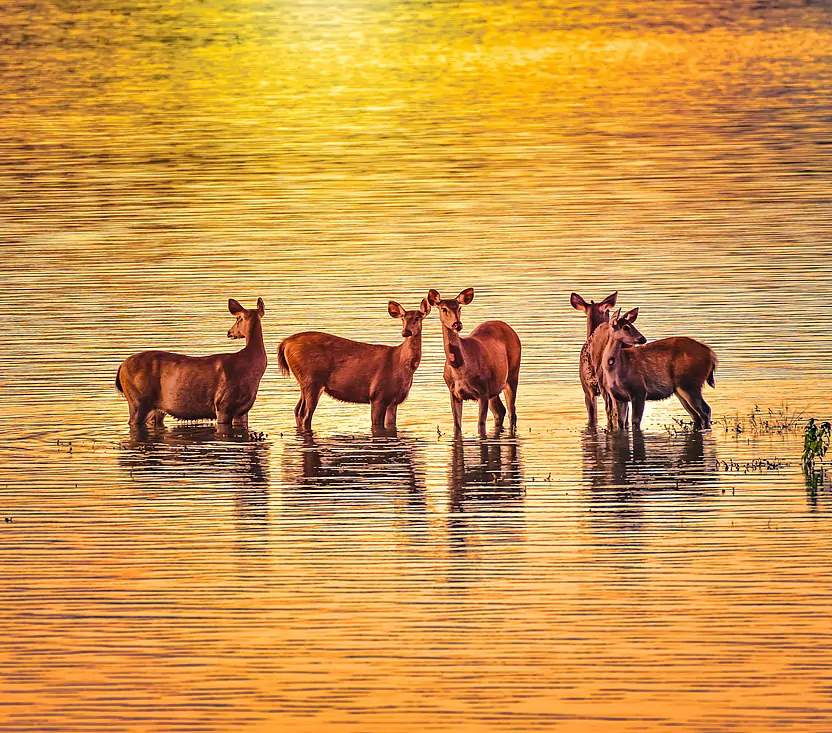
Apart from these major predators, Pench National Park offers a safe shelter to over 39 species of mammals, 13 species of reptiles, and 3 species of amphibians. The park is highly populated with herbivores like Chital (spotted deer), Sambar deer, Barking deer, and Nilgai. This popular national park is also globally renowned for its exceptional avifauna, hosting more than 285 species of resident and migratory birds, including the Malabar Pied Hornbill, Indian Pitta, and various majestic eagles.

Flora in Pench National Park

The flora of Pench National Park is deeply mesmerizing and highly popular among wildlife tour enthusiasts and botanists. Primarily, the vegetation of Pench Tiger Reserve is categorized into Southern Tropical Dry Deciduous Teak Forests and Tropical Mixed Deciduous Forests. The park is heavily dominated by magnificent and towering Teak trees (Tectona grandis), which are beautifully intermixed with lush open meadows and bamboo thickets. This unique and dense green canopy forms the core natural habitat, providing excellent shelter and camouflage for tigers and their prey.

This beautiful landscape of Pench National Park is continuously immersed and nourished by the pristine Pench River, which snakes through the entire tiger reserve. Apart from the dominant teak trees, this forest is famous for accommodating sacred trees like Mahua, Kullu (Ghost Tree), Palash (Flame of the Forest), Amaltas, and beautiful flowering shrubs in abundance. The seasonal blooming of these trees offers a highly colorful and mesmerizing ambience to the park. The look of this national park gets enhanced by the presence of dense bamboo groves and vast savannah grasslands.

The legendary surroundings of the Pench Tiger Reserve served as the actual inspiration for Rudyard Kipling's world-famous classic 'The Jungle Book', making it a prime factor to attract thousands of international and domestic tourists every year. All these geographical factors and rich vegetation make the flora of Pench National Park deeply unforgettable and a must-visit eco-tourism hotspot in Central India.

Topography Of Pench National Park

The topography of Pench National Park is characterized by a stunning undulating terrain of small hills, valleys, and seasonal streams. Unlike flood-plain ecosystems, the land here is dominated by tropical dry deciduous forests and vast teak canopies. The beauty of the rocky terrains and open grasslands is enhanced by the presence of scattered trees of Mahua (Madhuca indica), Palash (Flame of the Forest), and the unique Kullu (Ghost Tree). These trees offer a typical Central Indian woodland look, providing a mesmerizing landscape. The pristine Pench River flows right through the center of the tiger reserve, creating beautiful water pools and islands that attract diverse wildlife and break the monotony of the dense forest patches.

ACTIVITIES TO DO IN PENCH NATIONAL PARK

Tourists can explore Pench National Park to experience lifetime unforgettable moments. The most thrilling and primary mode to experience the rich flora and fauna is by taking an open-top Jeep Safari, which allows deep exploration into the core zones of the tiger reserve under the guidance of expert naturalists.

Jeep Safari

Tourists can enjoy an exciting Jeep Safari ride to explore the core and buffer zones of Pench National Park. It is the most appropriate, popular, and safest safari option to track the majestic Royal Bengal Tigers and leopards in their natural habitat.

Nature Walk & Night Safari

Tourists can explore the pristine wilderness of the park by indulging in a guided nature walk on foot in the specified buffer zones. Additionally, Pench Tiger Reserve offers unique Night Safaris in its buffer areas, which is a memorable experience best suited for adventure seekers and nocturnal wildlife lovers.

Birding in Pench National Park

This national park is vastly famous for bird watching, hosting over 285 species of birds. Bird watchers experience immense pleasure and capture numbers of unforgettable experiences for their lifetime while spotting rare resident and migratory birds.

How To Reach Pench National Park?

  • By Air:-

  • The nearest airport is Dr. Babasaheb Ambedkar International Airport in Nagpur (Maharashtra), which is just about 90-100 kms away from the major safari gates of Pench Tiger Reserve. Jabalpur Airport (Madhya Pradesh) is another option, located around 200 kms away.

  • By Rail:-

  • The nearest major railway station is Nagpur Railway Junction, which is exceptionally well-connected to all major cities in India and is just a comfortable 2 to 2.5-hour drive from Pench.

  • By Road:-

  • If you are interested to travel to Pench National Park by road, it is easily accessible via the clean National Highway 44 (NH44). You can easily take a cab or regular bus service from Nagpur or Jabalpur straight to the park entry gates.

Safari Tips In Pench National Park

  • Pench National Park offers morning Jeep Safari rides (usually starting around 6:00 AM) and afternoon safari rides (starting around 3:00 PM). Timings shift slightly according to the winter and summer seasons.
  • It is highly recommended to book your Pench safari permits online well in advance, as the number of vehicles entering the core zones is strictly limited by the forest department.
  • Tourists must reach the allocated safari gate at least 30 minutes before the scheduled entry time for mandatory permit and ID checks.
  • Always carry your original government-issued photo ID (Aadhar Card, Voter ID, or Passport for foreign tourists) that you used while booking the online permit.
  • Foreign tourists must carry a reasonable amount of Indian currency for local expenses and camera fees at the gate.
  • Tourists must carry a high-quality camera and binoculars in order to enhance their wildlife tracking and bird watching experience.
  • Always respect the forest rules: maintain silence inside the park, do not litter, and strictly follow all instructions given by your assigned forest guide and driver.

Best Time To Visit Pench National Park

The best time to visit Pench National Park is between the months of October and June. The core zones of the tiger reserve remain closed for tourists during the monsoon season (from July to September) for safety and conservation reasons. The winter months (November to February) offer very pleasant weather, while the summer months (April to June) are considered best for spotting tigers near the remaining water bodies.
Pench Fun Tour Package
Pench Fun Tour With 01 Jeep Safari

Explore the beautiful landscapes of Pench Tiger Reserve with a thrilling short weekend getaway and 1 core zone Jeep Safari...

Read More
Pench Holiday Tour Package
Pench Holiday Tour With 01 Jeep Safari

A perfect vacation package for families looking to relax near the national park along with an exciting morning wildlife tour...

Read More
Pench National Park Extended Tour
Pench National Park Tour With 2 Jeep Safari

Maximize your tiger tracking opportunities in Central India with our specialized tour including 2 comprehensive Jeep Safaris...

Read More
Pench Wildlife Expert Tour
Pench Wildlife Tour With 2 Jeep Safari

Designed for photographers and nature enthusiasts to experience the rich flora and fauna of the iconic Jungle Book forest...

Read More

Frequently Asked Questions

Pench National Park is primarily located in the Seoni and Chhindwara districts of Madhya Pradesh, India, with a portion of the reserve extending into the Nagpur district of neighboring Maharashtra.

Pench Tiger Reserve is world-famous for its high density of Royal Bengal Tigers and leopards. It is also globally renowned as the magical forest that inspired Rudyard Kipling’s famous classic tale, 'The Jungle Book'.

The major attractions include open-top Jeep Safaris to spot Bengal Tigers, leopards, and sloth bears. Guided nature walks, unique buffer zone Night Safaris, and the scenic beauty of the pristine Pench River are other top highlights.

Pench is an absolute paradise for bird watchers, hosting over 285 species including the Malabar Pied Hornbill, Indian Pitta, Crested Serpent Eagle, Changeable Hawk-Eagle, Indian Roller, and various colorful parakeets.

Apart from Royal Bengal Tigers and leopards, you can easily spot massive herds of Chital (spotted deer), Sambar deer, Gaurs (Indian Bison), Sloth Bears, Wild Boars, Jackals, and the endangered Indian Wild Dogs (Dholes).

The core safari zones remain open from October 15 to June 30 every year. The winter months (November to February) offer incredibly pleasant weather, while the peak summer months (April to June) are considered ideal for maximum tiger sightings near water bodies.